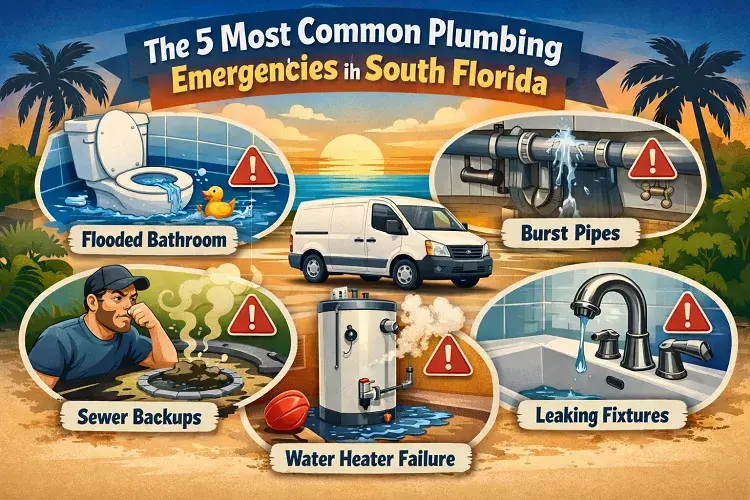
Living in South Florida is often described as living in paradise. But between the intense humidity, the corrosive salt air near the coast, and the high mineral content in the municipal water supply, South Florida is actually one of the most hostile environments in the country for residential plumbing.
Homeowners in Miami, Fort Lauderdale, and West Palm Beach face a very specific set of plumbing disasters that rarely happen in other parts of the United States. If you are not proactively maintaining your system, the unique Florida climate will eventually destroy your pipes, your appliances, and your drywall.
In this comprehensive guide, we break down the 5 most common plumbing emergencies in South Florida, how to identify the warning signs before disaster strikes, and exactly what to do when you need an emergency plumber right now.
1. The Polybutylene Pipe Time Bomb
If your South Florida home was built between 1978 and 1995, you might be sitting on a ticking time bomb.
During the housing boom of the 1980s and 90s, millions of Florida homes were built using Polybutylene (PB) piping. It was marketed as the cheaper, easier alternative to copper. Unfortunately, scientists later discovered that the chlorine and chemical additives present in the municipal Florida water supply react with the Polybutylene plastic.
Over the years, the water chemistry causes the plastic to become incredibly brittle, flaking away from the inside out.
The Emergency
Polybutylene pipes do not just develop small leaks; they catastrophically burst without any warning. Because the pipes degrade from the inside, they look perfectly fine on the outside until the moment they rupture, sending thousands of gallons of pressurized water through your drywall and flooding your home.
The Solution
If your home has grey plastic water supply lines, you must not wait for them to burst. Call a licensed plumber immediately to schedule a whole-home repiping. Modern PEX tubing is the gold standard for replacing Polybutylene, as it is highly flexible, affordable, and immune to chlorine degradation.
Need a Repipe Estimate? Call Our 24/7 Dispatch Center Today.
2. AC Condensate Drain Line Clogs
You might not think of your air conditioner as part of your plumbing system, but in South Florida, it absolutely is.
Because the humidity in South Florida is suffocating for nine months out of the year, your AC unit pulls gallons of moisture out of the air inside your home every single day. This moisture drips into a drain pan and is carried out of your house through a PVC pipe called the condensate drain line.
The Emergency
The warm, dark, and constantly wet environment inside the condensate line is the perfect breeding ground for thick algae and mold. If you do not regularly flush the line with vinegar, the algae will grow into a thick, slimy plug that completely blocks the pipe.
When the pipe clogs, the water backs up into the drain pan. If the safety switch fails, the pan will overflow, pouring gallons of water directly through your ceiling or into your walls, causing massive mold growth and structural damage.
The Solution
If your AC suddenly shuts off or you see water pooling around the indoor air handler, your condensate line is clogged. A licensed plumber or HVAC technician can use specialized suction equipment and compressed air to blast the algae clog out of the line and restore proper drainage.
3. Hard Water Heater Failure
South Florida relies heavily on the Biscayne Aquifer for its drinking water. Because this water travels through porous limestone, it picks up massive amounts of dissolved calcium and magnesium.
This results in extremely “hard water.” While safe to drink, hard water is the ultimate enemy of your water heater.
The Emergency
As your water heater heats the hard water, the calcium separates and falls to the bottom of the tank. Over the years, it forms a rock-solid layer of sediment. This sediment buries the heating element, causing the unit to work twice as hard to heat the water.
Eventually, the bottom of the metal tank becomes superheated and cracks. You will wake up to find your garage or utility closet completely flooded with 40 to 50 gallons of scalding hot water. If you hear a loud “popping” or “rumbling” noise coming from the tank, the water is boiling underneath the rock sediment, and the tank is at immediate risk of rupturing.
The Solution
You must call a plumber to perform a professional water heater flush at least once a year. If the tank is already making popping noises, it may need to be replaced entirely. To prevent the issue permanently, consider having a whole-home water softener installed to remove the calcium before it reaches the tank.
4. Tree Root Invasions in Older Sewer Lines
The tropical climate of South Florida allows for massive, beautiful landscaping, including massive banyan and oak trees. However, these trees have incredibly aggressive root systems.
The Emergency
During the drier winter months, tree roots actively search for moisture. If your home has an older clay or cast iron main sewer line with a tiny hairline crack, the roots will force their way inside.
Once inside, the roots are fertilized by your wastewater and grow rapidly, expanding into a thick web that completely chokes off the pipe. This causes raw sewage to back up into all of your ground-floor bathtubs and toilets simultaneously.
The Solution
Do not pour chemical drain cleaners down the sink; they will not destroy tree roots. You must hire a licensed plumber to perform a Fiber-Optic Camera Inspection. Once the roots are located, the plumber can use a high-pressure hydro-jetter to obliterate the roots, followed by trenchless epoxy pipe lining to permanently seal the crack so the roots can never return.
5. Corroded Cast Iron Pipes
If you live in a South Florida home built before 1975, your main sewer line is likely made of cast iron.
The Emergency
Cast iron has a lifespan of roughly 40 to 50 years. Because South Florida soil is incredibly moist and salty, cast iron pipes rust from the outside in, while the wastewater causes them to rust from the inside out. Eventually, the bottom of the cast iron pipe simply rots away, leaving the wastewater to dump directly into the dirt beneath your foundation. This causes foul sewage odors, constant backups, and even foundation sinking (sinkholes).
The Solution
A collapsed cast iron pipe is a major emergency that requires professional intervention. Using trenchless sewer repair technology, a licensed plumber can often insert a flexible resin liner into the rotting cast-iron pipe, curing it into a brand-new, PVC-quality pipe without having to rip up your expensive tile floors to reach the dirt below.
Need an Emergency Plumber in South Florida?
From exploding Polybutylene pipes to completely clogged sewer lines, South Florida plumbing emergencies require immediate, professional attention.
Trust Plumbing Repair Hub to connect you with top-rated, licensed plumbing professionals across Miami-Dade, Broward, and Palm Beach counties. Our vetted experts are stationed locally and are available 24/7 to stop active flooding, diagnose hidden leaks, and provide transparent estimates for permanent repairs.
Call (833) 205-7332 for Immediate Plumbing Help in South Florida.
Frequently Asked Questions
1. Why is Polybutylene pipe so bad in Florida?
Polybutylene (PB) pipes react negatively to the chlorine and chemical oxidants found in Florida’s public water supply. The chemicals cause the plastic pipes to flake and become highly brittle from the inside out, inevitably leading to catastrophic bursts and severe home flooding.
2. How do you clear a clogged AC condensate line?
For minor maintenance, you can pour a quarter cup of white vinegar down the AC condensate access pipe every month to kill algae. However, if the line is completely blocked and overflowing, a licensed professional must use a wet/dry vacuum and compressed air to safely clear the blockage without cracking the PVC pipe.
3. What causes a water heater to pop or rumble?
A popping or rumbling noise is caused by hard water sediment. The calcium in South Florida’s water solidifies at the bottom of the tank. When the heating element turns on, water trapped beneath this layer of solid rock boils and rises, creating the popping sound. This means your tank is overheating and is at high risk of rupturing.


