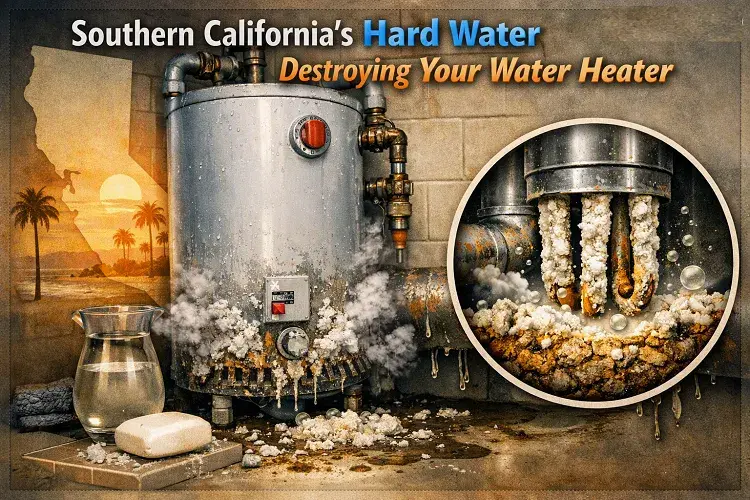
If you live in Southern California, you are likely no stranger to the white, crusty buildup that constantly appears on your showerheads and kitchen faucets. Most homeowners simply wipe it away with some vinegar and go about their day, dismissing it as a minor annoyance.
But what you can’t see is the devastating effect this same chalky substance is having on the most expensive plumbing appliance in your home: your water heater.
Southern California has some of the “hardest” municipal water in the entire country. While it is perfectly safe to drink, this mineral-heavy water is a silent killer for residential plumbing systems. If your hot water runs out faster than it used to, or worse, if you hear a strange “popping” or “rumbling” noise coming from your garage, your water heater is under attack.
In this guide, we’ll explain exactly what California’s hard water is doing to your plumbing, why that popping noise is a major red flag, and the steps you must take immediately to prevent a catastrophic, basement-flooding tank explosion.
What Exactly is “Hard Water”?
Water hardness is a measure of the dissolved minerals—specifically calcium and magnesium—present in the water supply.
In Southern California, our water travels hundreds of miles through the Colorado River aqueduct system and local groundwater basins. As the water moves through the earth and the concrete aqueducts, it absorbs massive amounts of these minerals. By the time it flows out of your tap in Los Angeles, Orange County, or San Diego, it is heavily saturated.
When hard water dries on a surface, the water evaporates, but the minerals are left behind. This is the white scale you see on your glass shower doors. Now, imagine that same scale building up inside a dark, pressurized metal tank 24 hours a day.
The Boiling Rock: Why Your Water Heater is Popping
The most common—and most terrifying—symptom of hard water damage is a loud popping, knocking, or rumbling noise coming from your water heater. If you hear this, you are not imagining things.
Here is exactly what is happening inside the tank:
1. The Sediment Layer Forms
As cold, mineral-rich city water enters your water heater, the heating element turns on. When water is heated, the dissolved calcium and magnesium separate from the liquid and fall to the bottom of the tank in the form of solid sediment. Over months and years, this sediment builds up, creating a thick, rock-like layer of calcium at the bottom of your water heater.
2. The Water Gets Trapped
Your water heater’s burner (if gas) or heating element (if electric) is located at the very bottom of the tank. As the sediment layer grows thicker, it buries the heating element. Water eventually seeps underneath this thick layer of rock-hard calcium.
3. The “Popping” Noise (Miniature Explosions)
When the burner turns on, it superheats the water trapped underneath the heavy sediment layer. That water begins to boil and turn into steam. Because steam expands, it violently forces its way up through the heavy layer of calcium rock to escape to the top of the tank.
That popping or rumbling noise you hear is literally boiling water exploding through a layer of solid rock inside a pressurized metal cylinder.
The 3 Devastating Consequences of Hard Water Sediment
If you ignore the popping noise, the sediment buildup will eventually destroy the appliance. Here is how hard water guarantees you will have to replace your unit years before you should have to:
1. Skyrocketing Energy Bills
Your water heater is designed to heat water, not rock. When a thick layer of calcium separates the burner from the water, the burner has to work twice as hard—and run twice as long—just to heat the water to your desired temperature. You are literally paying your utility company to heat a pile of rocks. This drastic drop in efficiency will cause your monthly gas or electric bill to skyrocket.
2. You Run Out of Hot Water Faster
A standard residential water heater holds 40 or 50 gallons of water. However, if the bottom 10 gallons of the tank are displaced by solid sediment, you now only have a 30-gallon tank. If your family used to be able to take three showers in a row, but now the water turns cold halfway through the second shower, hard water sediment is to blame.
3. The Tank Overheats and Ruptures
This is the worst-case scenario. Because the burner is constantly running, trying to push heat through the sediment layer, the bottom of the metal tank becomes superheated. This intense, localized heat destroys the glass lining inside the tank and weakens the metal. Eventually, the bottom of the tank will crack, sending 40 gallons of scalding hot water flooding into your garage, basement, or hallway.
How to Stop Hard Water Damage (Before the Tank Bursts)
If you live in Southern California and you hear your water heater popping, you are on borrowed time. You need to take immediate action to clear the sediment before the tank ruptures.
Immediate Action: Professional Water Heater Flushing
If your tank is less than 6 years old, it can likely be saved. You need to call a licensed local plumber immediately to perform a Professional Water Heater Flush.
While there are DIY tutorials on the internet for flushing a tank, attempting this yourself is highly dangerous if the sediment is severe. The calcium chunks can permanently clog the drain valve, leaving you with a broken valve pouring water onto your floor that you cannot shut off. A licensed plumber has the proper equipment to safely power-flush the heavy sediment out of the tank and inspect the anode rod (the component designed to prevent rust).
[BUTTON: Hear Popping Noises? Call Our 24/7 Dispatch Center to Schedule a Flush Today]
Long-Term Prevention: Whole-Home Water Softeners
Flushing the tank is a reactive measure. The only way to proactively stop hard water damage in Southern California is to install a Whole-Home Water Softener or Water Conditioner.
These systems are installed at the main water line where the city water enters your house. They use an ion-exchange process to physically remove the calcium and magnesium from the water before it ever touches your plumbing.
- Your water heater will last 5 to 10 years longer.
- Your showerheads and faucets will stop crusting over.
- Your skin and hair will feel significantly softer after showering.
Don’t Wait for the Flood
Southern California’s hard water is relentless. If your water heater is making strange noises, taking forever to heat up, or running out of hot water quickly, the calcium rock at the bottom of the tank is already causing severe damage.
Ignoring the problem will inevitably result in a flooded home and a costly emergency replacement.
Trust Plumbing Repair Hub to connect you with top-rated, licensed plumbing professionals in your specific California zip code. Our vetted experts can safely flush your failing water heater, restore your hot water pressure, and provide transparent estimates for protective water softening systems.
Call (833) 205-7332 for Immediate Plumbing Help
Frequently Asked Questions
Is a popping water heater dangerous?
Yes. A popping or rumbling noise means water is boiling underneath a heavy layer of sediment at the bottom of the tank. This causes the metal tank to overheat and severely weakens the structure, drastically increasing the risk that the bottom of the tank will crack and cause massive flooding in your home.
Can I flush a water heater myself?
While basic maintenance flushing is possible, attempting to flush a severely neglected water heater yourself is risky. Large chunks of calcium sediment can become permanently lodged in the plastic drain valve, preventing it from closing. This will result in a continuous leak that requires an emergency plumber to fix.
How often should a California water heater be flushed?
Because Southern California has exceptionally hard water, manufacturers and licensed plumbers strongly recommend flushing your traditional tank water heater at least once every 12 months. If you have a tankless water heater, it must be descaled annually with a vinegar solution to prevent the heat exchanger from failing.
Does a water softener really extend the life of a water heater?
Yes. By removing the hard minerals (calcium and magnesium) from the water supply, a water softener prevents sediment from forming inside the tank. This allows the burner to operate efficiently and eliminates the overheating that typically destroys water heaters, extending the appliance’s lifespan by up to 50%.
Keep Reading: Mineral buildup doesn’t just cause errors; it can also affect your home’s water flow. Learn the common causes of low water pressure in homes and why you might hear a popping noise coming from your water heater.


