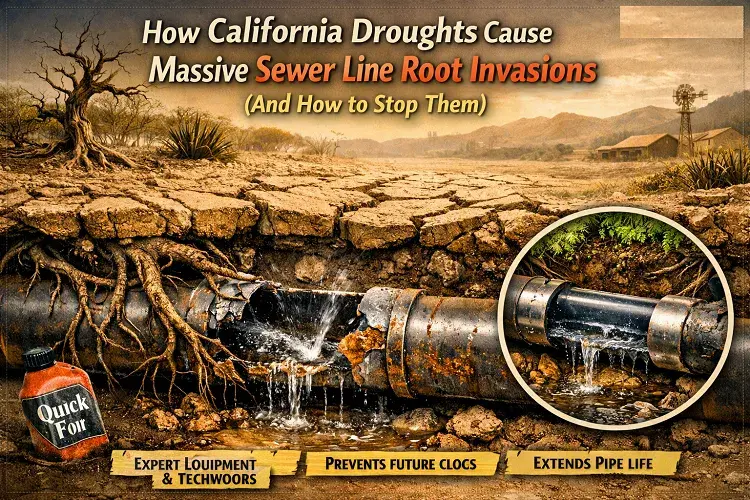
Living in California means enjoying beautiful weather, stunning coastlines, and gorgeous landscaping. But it also means living with the constant reality of extreme weather cycles. Between the intense, multi-year droughts and the bone-dry Santa Ana winds, California homeowners are well aware of the toll the climate takes on their lawns and gardens.
However, there is a massive, hidden disaster happening right beneath your feet that most homeowners never think about until it is too late: Sewer Line Root Invasions.
When California experiences a prolonged drought, the giant, beautiful, established trees in your neighborhood get desperate for water. And those trees know exactly where to find an endless supply of water and nutrients—flowing right through the main sewer line buried beneath your front yard.
In this guide, we are going to explain exactly how California droughts trigger massive plumbing failures, how to spot the early warning signs of an invasion, and how modern Trenchless Sewer Repair can save you from a 15,000 USD landscaping nightmare.
The Anatomy of a Root Invasion: How Trees Crush Pipes
To understand why this happens, you have to look at the history of California real estate. During the massive post-WWII housing booms across Los Angeles, Orange County, the Bay Area, and San Diego, contractors primarily used vitrified clay pipes or cast iron pipes for underground sewer lines.
While these materials were the standard at the time, they have two major weaknesses:
- Clay pipes become incredibly brittle over decades of seismic soil shifting.
- Cast iron pipes eventually rust and rot from the inside out.
When the California soil dries out during a severe drought or a brutal heatwave, the massive Oak, Eucalyptus, and Ficus trees that line our streets go into survival mode. Their roots stretch out aggressively, sometimes traveling dozens of feet, searching for moisture.
If your aging clay or cast iron sewer pipe has even a microscopic hairline crack, hot water vapor escapes into the dry soil. The tree roots sense this vapor and grow directly toward the pipe. A root tip, as thin as a human hair, forces its way into the crack to drink the water inside.
The Blockage and the Burst
Once inside the pipe, the root finds a constant flow of water and fertilizer. It grows rapidly, expanding into a massive, thick web of roots (known as a “root ball”).
As the roots grow thicker, they act like a wedge, slowly splitting the heavy clay or cast iron pipe completely open. Inside the pipe, the root ball acts like a net, catching every piece of toilet paper, grease, and waste that flows out of your home. Eventually, the pipe is completely choked off, forcing raw sewage to back up into your bathtubs, showers, and sinks.
Are Your Drains Gurgling? Click Here to Request an Immediate Fiber-Optic Camera Inspection.
The 4 Early Warning Signs of Roots in Your Sewer Line
Sewer line root invasions do not happen overnight. The tree slowly chokes your plumbing over months or years. If you know what to look for, you can catch the invasion before the pipe completely collapses.
If you notice any of these four warning signs, you need to call a licensed plumber immediately:
1. The Gurgling Toilet
If you run the water in your bathroom sink and your toilet bowl starts to bubble or “gurgle,” that means air is trapped in your plumbing system. The root ball is blocking the airflow and the water flow in your main sewer line.
2. Slow Drains Across the Entire House
A single slow-draining sink usually just means a local hair clog in the P-trap. However, if your kitchen sink, guest bathroom shower, and master bathroom tub are all draining slowly at the same time, the blockage is deep in the main underground sewer line.
3. Foul Odors in the Yard
When a tree root cracks your sewer pipe open, raw sewage begins leaking directly into the soil beneath your lawn. If you walk outside on a hot California day and smell a distinct, foul sewage odor near your foundation or driveway, your pipe is heavily compromised.
4. Unusually Green Patches of Grass
If California is in the middle of a brutal summer drought, your lawn should look slightly brown and dry. If you notice a single, perfectly lush, dark green patch of grass in your front yard, that grass is being fertilized by raw sewage leaking from a cracked pipe below.
Why “Chemical Root Killers” Are a Dangerous Scam
If a homeowner suspects roots in their pipes, their first instinct is often to drive to the local hardware store and buy a jug of “Chemical Root Killer” or harsh drain cleaners like Drano.
Do not do this.
Chemical root killers are highly toxic. Furthermore, if you pour a harsh acid down a pipe that is already cracked and compromised by tree roots, the acid will literally eat through whatever is left of the pipe, causing a complete structural collapse. You will instantly turn a repair job into a massive, full-scale excavation project.
The Permanent Fix: Trenchless Sewer Repair
Twenty years ago, if a tree root crushed your sewer line, a plumbing company would have to bring in a backhoe. They would spend days jackhammering your driveway, destroying your expensive landscaping, and tearing up your sidewalk just to reach the broken pipe. This method often costs homeowners well over 10,000 USD just in cosmetic repairs to their property after the plumbing was fixed.
Today, advanced plumbing technology has made excavation obsolete. The solution is Trenchless Sewer Repair.
Step 1: The Fiber-Optic Camera Inspection
The process starts with a high-definition, fiber-optic sewer camera. A licensed technician feeds the camera down your cleanout drain to get a live, 1080p view of the inside of your pipes. This allows them to pinpoint the exact location and severity of the root invasion without digging a single hole.
Step 2: High-Pressure Hydro-Jetting
Once the roots are located, the plumber uses a Hydro-Jetting machine. This tool blasts water at 4,000 PSI into the pipe, safely obliterating the tree roots and flushing them out to the city sewer main.
Step 3: Epoxy Relining (CIPP)
With the pipe cleared, the trenchless repair begins. The technician pulls a flexible, resin-coated tube (a liner) through your existing damaged pipe. Once in place, the resin is inflated and cured using heat or UV light.
Within a few hours, the resin hardens into a rock-solid, seamless, structural pipe inside the old pipe. Because this new inner pipe has absolutely no joints or seams, it is 100% root-proof. Tree roots cannot grip it or crack it.
Stop the Roots Before They Destroy Your Pipes
California droughts are inevitable, and the massive trees in your neighborhood will always look for water. If your home was built before 1980, your clay or cast iron pipes are a prime target.
Do not wait until raw sewage is flooding your bathrooms and your pipe has completely collapsed. If you notice slow drains, gurgling toilets, or bad odors, you need a professional camera inspection today.
Protect Your Home & Save Your Yard – Schedule a Trenchless Camera Inspection Today.
Keep Reading: Protect Your Home’s Plumbing
Professional Solutions: If you suspect tree roots have invaded your pipes, do not ignore the warning signs. Learn more about our professional Trenchless Sewer Line Repair services, or schedule an immediate Drain Camera Inspection to see exactly what is hiding in your underground pipes.
Why DIY Fails: Thinking about using a chemical root killer? Think again. Read our comprehensive guide on Why Liquid Plumr and Drano are Destroying Your Pipes to understand why chemical fixes usually result in massive, expensive pipe collapses.


