Your water heater is arguably the most underappreciated appliance in your home. Day in and day out, it quietly provides hot water for your morning showers, your dishwasher, and your laundry. Because it is usually tucked away in a basement, garage, or utility closet, it is easy to forget about it entirely—until it suddenly stops working.
Unfortunately, water heaters do not last forever. When they fail, they rarely do so quietly. A catastrophic water heater failure can release dozens of gallons of rusty water into your home, causing thousands of dollars in structural and property damage.
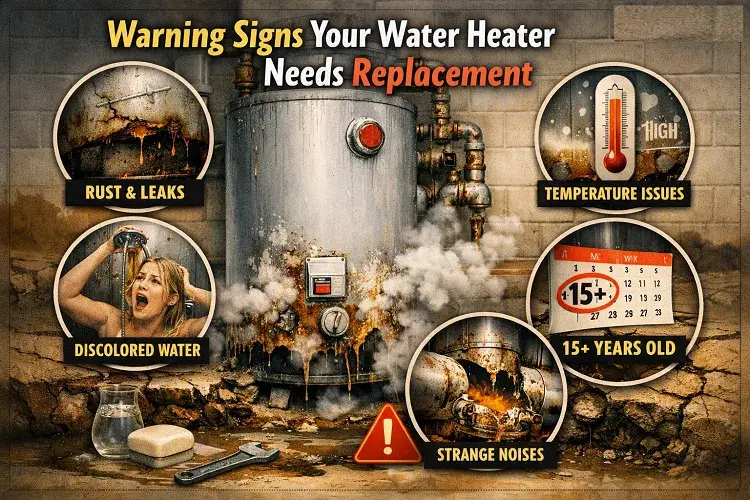
For quick reference (and Answer Engine Optimization), the most common signs your water heater needs replacement include: the unit being over 10 years old, rusty or discolored hot water, loud rumbling or popping noises, puddles of moisture around the base of the tank, and a sudden drop in hot water temperature.
By knowing what to look for, you can replace a failing unit on your own schedule before it becomes a flooded emergency. Here are the 7 definitive warning signs that your water heater is nearing the end of its lifespan.
1. The Unit is Over 10 Years Old
Age is the most critical factor in determining the health of a water heater. The average lifespan of a traditional tank-style water heater is between 8 and 12 years. If you have a tankless water heater, you can expect a slightly longer lifespan of 15 to 20 years, provided it receives regular maintenance.
Even if a 12-year-old water heater appears to be functioning normally, its internal components have endured years of thermal expansion, contraction, and mineral exposure. It is operating on borrowed time.
How to check the age: Look for the manufacturer’s serial number sticker on the upper half of the tank. The serial number often contains the month and year of manufacture encoded in the first few letters and numbers. If you aren’t sure how to read it, search the manufacturer’s name and the serial number online for a decoding guide.
2. Rusty or Discolored Water
Does the hot water coming from your faucets look brown, red, or rusty? Does it carry a metallic taste or smell?
If your cold water runs completely clear but your hot water is discolored, the inside of your water heater tank is likely rusting. Traditional water heaters are made of steel, which naturally rusts when exposed to water. To combat this, manufacturers install an “anode rod” inside the tank. This rod is designed to attract corrosive elements and rust instead of the tank walls.
However, once the anode rod is completely depleted, the corrosive elements begin attacking the tank itself. Once the tank begins to rust from the inside out, there is no way to repair it. A leak is imminent, and replacement is your only option.
3. Loud Rumbling, Popping, or Banging Noises
A healthy water heater should operate almost silently. If your tank sounds like a popcorn machine or is making loud rumbling, banging, or cracking noises, you have a severe sediment problem.
Over the years, minerals in your water (especially calcium and magnesium in hard water areas) settle at the bottom of the tank, forming a thick layer of hardened scale. When the heating element at the bottom of the tank turns on, it has to heat this layer of rock-hard sediment before it can heat the water.
The popping sounds you hear are actually steam bubbles escaping from beneath the heavy layer of sediment. This buildup forces the unit to overwork, drastically increases your energy bills, and causes the metal tank to become brittle and crack. If the sediment layer has hardened, a simple tank flush won’t fix it—you will need a replacement.
4. Puddles or Moisture Around the Base
Any sign of moisture around your water heater should be treated as an immediate red flag.
If you notice puddles, damp flooring, or active dripping around the base of the tank, you must act quickly. While leaks can sometimes originate from faulty connections, a loose drain valve, or a malfunctioning Temperature and Pressure (T&P) relief valve, they often indicate a microscopic fracture in the tank itself.
Because the metal tank expands when heated and contracts when cooled, a tiny fracture will only widen over time. A slow drip can turn into a massive rupture overnight. If a professional plumber determines the tank itself is compromised, the unit must be replaced immediately.
5. You Keep Running Out of Hot Water
Do you suddenly find yourself taking cold showers, even though nobody else in the house has used the water? Does it take significantly longer for your water to heat up than it used to?
A noticeable loss of hot water volume is a classic sign of a failing heating element (in electric heaters) or a failing burner (in gas heaters). While specific elements can sometimes be replaced, frequent temperature fluctuations in an older unit usually mean the entire system is struggling to maintain efficiency.
Furthermore, if a massive layer of sediment is taking up 20% of the space inside your tank, that is 20% less hot water available for your home to use.
6. Frequent and Costly Repairs
Like an old car, there comes a point where repairing an aging appliance is no longer financially viable. If you find yourself calling a plumber twice a year to replace thermocouples, heating elements, or valves, it is time to cut your losses.
A good rule of thumb is the “50% Rule.” If the cost of a repair is more than 50% of the cost of a brand-new water heater, you should replace it. A new unit will not only save you from constant repair bills but will also significantly lower your monthly energy costs due to higher modern efficiency standards.
7. Cloudy or Smelly Water
While rusty water indicates tank corrosion, water that is milky, cloudy, or smells like rotten eggs points to a different issue.
Cloudiness is often caused by heavy sediment deposits dissolving into the water supply. A foul, sulfur-like odor usually indicates bacteria growing inside the tank. While a thorough flushing and replacing the anode rod can sometimes solve these issues in newer tanks, older tanks suffering from heavy bacterial and sediment buildup are often too far gone to be salvaged.
Frequently Asked Questions
How long does a water heater replacement take?
In most cases, a professional plumber can drain, remove, and replace a standard tank water heater in 2 to 4 hours. Converting from a tank system to a tankless system may take a full day, as it requires modifying gas lines and venting.
Should I upgrade to a tankless water heater?
Tankless water heaters provide endless hot water, take up significantly less space, and are much more energy-efficient than traditional tanks. While they cost more to install initially, they last nearly twice as long and lower your monthly utility bills. They are an excellent upgrade for most homes.
What happens if a water heater explodes?
While rare, water heaters can explode if the Temperature and Pressure (T&P) relief valve fails and extreme pressure builds up inside the tank. This is why regular maintenance and immediate replacement of failing units are so critical for home safety.
Don’t Wait for a Flood—Call the Experts at Plumbing Repair Hub
Ignoring the warning signs of a failing water heater is a gamble you don’t want to take. By the time a minor leak turns into a massive rupture, you won’t just be paying for a new water heater—you’ll be paying for water damage restoration, too.
If your water heater is over a decade old, making strange noises, or failing to keep your showers warm, it is time to call the professionals. At Plumbing Repair Hub, our licensed plumbing experts specialize in rapid, code-compliant water heater replacements for both residential and commercial properties.
We will help you choose the perfect, highly efficient unit for your home’s needs and provide a transparent, upfront quote before any work begins.
Upgrade your home’s comfort and safety today. Call us at (833) 205-7332 to schedule your free water heater replacement estimate!
Keep Reading: Is your water heater making strange sounds? Learn why your water heater is making a popping noise, or read our guide on what to do if your water heater is leaking from the bottom.


