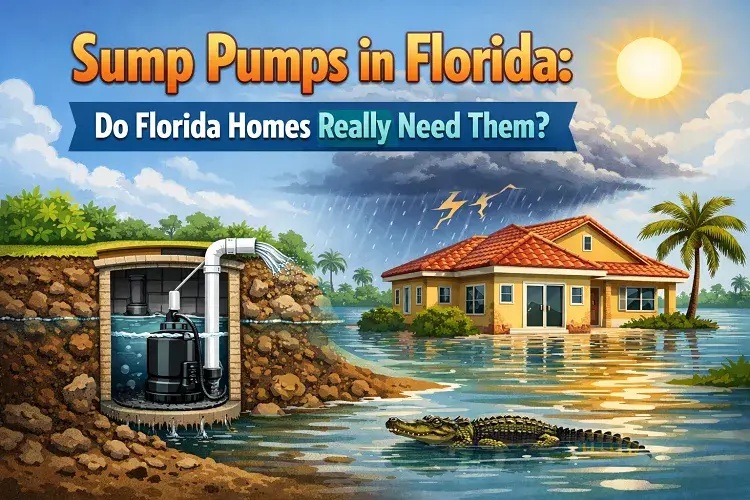
If you have ever owned a home or lived in the Midwest, Northeast, or mid-Atlantic regions, you probably know exactly what a sump pump is. In those parts of the country, a sump pump sits quietly in a basement pit, pumping out rising groundwater to keep the home’s lower level bone-dry.
But what about the Sunshine State? If you look at the architectural landscape of Florida, you will notice one glaring difference immediately: almost nobody has a basement.
Because Florida homes are primarily built on concrete slabs or crawlspaces right at or slightly above sea level, a common misconception has spread among homeowners from Pensacola down to the Florida Keys: “Florida homes don’t have basements, so Florida homes don’t need sump pumps.”
This is a dangerous misunderstanding of local geography, modern building codes, and tropical weather patterns. While you might not need a pump to save a traditional basement, hundreds of thousands of Florida properties absolutely require a sump pump to protect their crawlspaces, low-lying foundations, and mechanical rooms from catastrophic water damage.
At Plumbing Repair Hub, we engineer, install, and service heavy-duty, storm-ready sump pump systems across the entire state of Florida. If your property suffers from standing water after an afternoon downpour, or if your crawlspace smells perpetually musty, call our team today at (833) 205-7332 to schedule a professional drainage evaluation.
The Reality of Florida’s Hydrogeology: Why Water Attacks from Below
To understand why a Florida home would need a sump pump, you have to look at what is happening directly beneath your grass. Florida sits on a massive, highly porous limestone shelf that acts like a gigantic underground sponge. This sponge holds our freshwater aquifers.
Because the state is relatively flat and surrounded by ocean, the water table—the boundary between unsaturated soil and completely saturated ground—is incredibly close to the surface.
When a tropical depression, hurricane, or standard summer storm dumps several inches of rain over a short period, two things happen simultaneously:
The sandy surface soil becomes completely saturated and cannot absorb water fast enough.
The underground aquifer rises rapidly toward the surface.
This traps your home’s foundation or crawlspace in a high-pressure water sandwich. This phenomenon, known as hydrostatic pressure, forces water upward through microscopic pores in your concrete slab or directly into your open crawlspace. Without a dedicated mechanical path to escape, this water will pool, warp your flooring, destroy your drywall, and compromise your home’s structural framing.
3 Scenarios Where a Florida Home Absolutely Needs a Sump Pump
If you aren’t sure whether your specific property requires a sump pump system, check if your home matches one of these three common Florida architectural risk profiles:
1. Homes Built on Crawlspaces (Common in Older & Coastal Towns)
If your home was built on piers, blocks, or a traditional crawlspace—frequently found in historic areas like Saint Augustine, Tampa Heights, or older coastal neighborhoods—you have a dirt or gravel void beneath your living room floors.
During heavy rain, groundwater seeps up through this dirt floor. If that water puddles and stands, the intense subtropical heat turns your crawlspace into a sauna. This triggers rapid wood rot in your floor joists and creates an ideal breeding ground for toxic black mold that migrates into your indoor air ducts. A crawlspace sump pump collects this rising water in a sealed basin and pumps it far away from your foundation before it can evaporate upward.
2. Properties with Below-Grade Mechanical Rooms or Elevator Shafts
Many modern multi-story homes along the coast, as well as commercial properties across Florida, feature elevator shafts, below-grade storage units, or sunken mechanical utilities. Because these structural pits are dug several feet below the standard ground level, they routinely dip straight into the local water table. A heavy-duty sump pump is legally required by building codes in these configurations to prevent electrical shorts, equipment ruin, and structural flooding.
3. Low-Lying Slabs Prone to Yard Flooding and Negative Grading
Does your backyard turn into a temporary lake every time it rains? If your home was built in a low-lying basin, or if successive landscaping projects have left your property with negative grading (where the yard slopes toward your house rather than away from it), stormwater will naturally pool against your exterior foundation walls.
In this scenario, an outdoor exterior sump pump system—often integrated into a French drain network—intercepts that pooling surface water and pumps it out toward the municipal stormwater street drains before it can seep inside your home.
The Anatomy of a Florida-Grade Sump Pump System
A standard retail plastic sump pump bought off the shelf might work fine in a dry northern basement, but it will quickly fail under the extreme demands of a Florida storm season.
At Plumbing Repair Hub, we install commercial-grade, corrosion-resistant systems engineered specifically to withstand our harsh coastal environments:
Early Warning Signs You Need an Immediate Drainage Evaluation
You shouldn’t wait for standing water to ruin your baseboards before taking action. Look for these early, subtle indicators that groundwater is invading your Florida property:
A Persistent, Musty Odor: If your home smells damp or earthy whenever the AC kicks on, moisture is actively accumulating beneath your feet.
Cupping or Buckling Hardwood Floors: If your wood planks are starting to raise or curve at the edges, moisture vapor is pushing up through the concrete slab beneath them.
Efflorescence along Masonry Walls: If you see a white, chalky, powdery substance coating your lower brick, block, or concrete walls, that is salt left behind by evaporating groundwater pushing through the masonry.
Contact Florida’s Foundation Drainage Experts Today
Whether you are trying to dry out a humid crawlspace in Jacksonville, safeguard an elevator pit in Miami, or stop backyard flooding in Orlando, the team at Plumbing Repair Hub has you covered. We understand Florida’s unique soil structures, water tables, and weather extremes better than anyone.
We bring the cutting-edge diagnostic tools, upfront transparent pricing, and storm-hardened equipment needed to keep your property permanently dry and structurally sound.
Don’t gamble with Florida’s unpredictable tropical weather patterns. Protect your foundation, your indoor air quality, and your property value before the next major storm system approaches. Call our local statewide dispatch line right now at (833) 205-7332 to schedule an expert sump pump and drainage consultation today.


