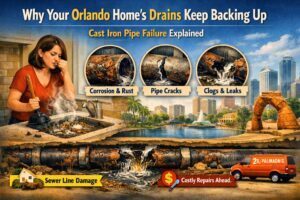
Orlando is famous for its beautiful historic neighborhoods. Walking through Thornton Park, College Park, or Delaney Park, you are surrounded by stunning mid-century modern homes and classic 1920s bungalows.
These homes carry incredible charm and architectural history. Unfortunately, they also carry a hidden, catastrophic flaw buried directly beneath their foundations: cast iron plumbing.
If your Orlando home was built before 1975, your main sewer line and internal drainage pipes are almost certainly made of cast iron. While this metal was the industry standard for over 50 years, it was never designed to last forever. In fact, plumbers generally agree that cast iron has a maximum lifespan of 40 to 50 years.
If you do the math, that means every single cast iron pipe in Orlando has already reached the end of its lifespan.
If you are dealing with constantly clogged toilets, slow-draining showers, or a persistent foul odor in your home, you are not dealing with a simple clog. You are dealing with structural pipe failure. In this guide, we will explain exactly why your cast iron pipes are rotting from the inside out and how modern trenchless sewer repair can fix the problem without destroying your historic home.
1. The Anatomy of Cast Iron Pipe Failure
To understand why your drains are failing, you have to understand what is happening to the metal underneath your floors. Cast iron pipe failure is not a sudden event; it is a slow, agonizing process of corrosion.
There are two distinct ways your pipes are currently dying:
Internal Corrosion (The Channeling Effect)
Every time you flush a toilet or run the washing machine, the wastewater flows across the bottom of the cast iron pipe. Over decades, the hydrogen sulfide gases naturally present in human waste turn into highly corrosive sulfuric acid.
This acid actively eats away at the bottom of the iron pipe. It creates a rough, jagged “channel” along the bottom of the pipe. As this channel gets deeper and rougher, toilet paper and solid waste begin to catch on the jagged edges, creating constant, stubborn clogs.
Eventually, the acid eats completely through the bottom of the pipe. When this happens, your raw sewage no longer travels to the city sewer; it dumps directly into the dirt beneath your home’s foundation.
External Corrosion (The Florida Soil Problem)
While the inside of the pipe is being destroyed by acid, the outside of the pipe is being destroyed by Orlando’s environment. Florida soil is highly acidic, moist, and often rich in salt from the coastal winds.
When buried in this wet, acidic soil, the exterior of the cast iron pipe begins to rust and scale. The metal actually thickens as it oxidizes, causing the pipe to become incredibly brittle. A slight shift in the ground or a period of heavy rain is all it takes to snap the weakened, brittle pipe entirely.
2. The 4 Warning Signs of Cast Iron Failure
Because your plumbing is hidden behind walls and buried under concrete slabs, you cannot see the rust. However, your home will display several glaring warning signs before the pipe completely collapses:
1. Chronic, Unexplained Backups
If you have to plunge your toilet every single week, or if you call a plumber to snake your drain only for it to clog again two weeks later, you do not have a simple blockage. The jagged, rusted interior of your cast iron pipe is constantly snagging debris. Plunging only temporarily pushes the water past the rust; it does not fix the pipe.
2. Foul Sewage Odors
Your plumbing system is a closed loop designed to vent toxic gases safely out of your roof. If you walk into your living room or bathroom and smell a distinct, sulfurous “rotten egg” odor, the closed loop has been broken. The cast iron pipe has rotted through, and raw sewage gases are leaking directly into your home.
3. Pest Infestations (Roaches and Rats)
This is the symptom that most homeowners ignore. If you suddenly have a severe roach problem or notice rats around your property despite keeping a clean house, they might be coming from your plumbing. When a cast iron sewer pipe cracks open underground, pests from the city sewer system use that crack as a superhighway straight into your walls.
4. Foundation Cracks and Sinkholes
When the bottom of the cast iron pipe rots away, gallons of wastewater dump into the soil directly beneath your home’s concrete foundation slab. Over time, this constant flow of water washes the soil away, creating a void. Without the soil to support it, the concrete foundation will eventually crack, sink, or collapse entirely into the void.
3. The Traditional Nightmare: Trenching
In the past, fixing a failed cast iron sewer line in a historic Orlando home was a nightmare.
Because the pipes are buried under the foundation, plumbers had to use jackhammers to tear up the beautiful hardwood floors, shatter the concrete slab, and dig massive trenches through the living room just to reach the pipes. The homeowner was forced to move out of the house for weeks, and the structural repair bill could easily exceed 30,000 USD, not including the cost to replace the destroyed flooring.
Many homeowners put off repairing their slow drains simply because they were terrified of the trenching process.
4. The Modern Solution: Trenchless Sewer Repair
Fortunately, plumbing technology has evolved. You no longer have to destroy your historic Orlando home to fix your failing cast iron pipes.
If you contact a licensed plumber immediately—before the cast iron pipe completely collapses into the dirt—they can use Trenchless Sewer Repair (CIPP Epoxy Lining) to save your plumbing system.
How Trenchless Repair Works:
- Camera Inspection: A plumber feeds a high-definition fiber-optic camera into your pipe to visually locate the rusted sections and ensure the pipe has not fully collapsed.
- Hydro-Jetting: Using a specialized high-pressure water jet, the plumber blasts the jagged rust and scale off the inside walls of the cast iron, restoring it to its original diameter.
- Epoxy Lining: A flexible tube saturated with heavy-duty epoxy resin is inserted into the cleaned pipe.
- Curing: The tube is inflated, pressing the epoxy tightly against the inside walls of the old cast iron. Within hours, the epoxy cures and hardens into a brand-new, structurally perfect plastic pipe inside the old one.
This entire process is done through a single, small access point. No jackhammers, no torn-up floors, and no destroyed landscaping. You get a brand-new, seamless pipe that is guaranteed to last for decades, and it is usually completed in a single day.
Don’t Wait for a Complete Collapse
Cast iron pipe failure is not a matter of “if,” but “when.” If your historic Orlando home is experiencing slow drains, frequent backups, or foul odors, the clock is ticking.
If you wait until the pipe completely collapses and fills with dirt, trenchless repair is no longer an option. You will be forced to jackhammer your foundation.
Trust Plumbing Repair Hub to connect you with top-rated, licensed plumbing professionals right here in Orlando. Our vetted experts will perform a comprehensive fiber-optic camera inspection to diagnose the exact state of your cast iron pipes and provide transparent estimates for minimally invasive trenchless repairs.
Drains Backing Up? Call (833) 205-7332 to Schedule a Camera Inspection Today.
Keep Reading: Broken underground pipes lead to massive home damage. Learn the warning signs of an under-slab pipe leak and what to do if you find sewage backing up in your bathtub.
Frequently Asked Questions
1. How long do cast iron sewer pipes last in Florida?
While cast iron is a durable material, the highly acidic and moist soil in Florida significantly reduces its lifespan. Plumbers generally agree that cast iron sewer pipes in Orlando will begin to fail after 40 to 50 years. If your home was built before 1975, your pipes have already reached the end of their usable life.
2. Can you line cast iron pipes instead of replacing them?
Yes. As long as the cast iron pipe has not completely collapsed or lost its structural integrity, a licensed plumber can use CIPP (Cured-In-Place Pipe) trenchless epoxy lining. This creates a brand-new, seamless plastic pipe inside the old cast iron pipe without having to dig trenches or jackhammer your concrete slab.
3. Why does my house smell like sewage but I can’t find a leak?
If you smell sewage but cannot see a leak, the problem is likely underground. As cast iron pipes age, the top of the pipe often cracks or rots away due to hydrogen sulfide gas corrosion. This allows toxic sewer gases to escape the pipe and vent directly up into the walls and floors of your home.
3. Is a sewer camera inspection worth it?
Absolutely. A fiber-optic sewer camera inspection is the only way to definitively diagnose the condition of your underground cast iron pipes without digging up your yard. It takes the guesswork out of the repair and allows the plumber to determine if affordable trenchless pipe lining is a viable option for your home.


