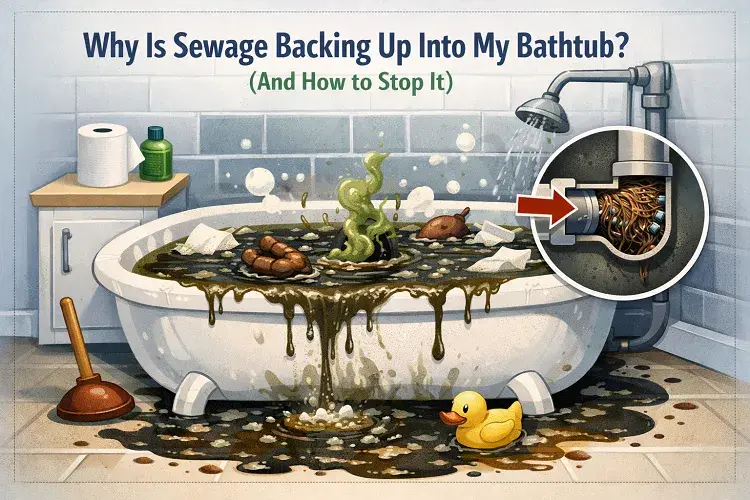
The Quick Answer: Sewage backs up into your bathtub because your home’s main sewer line is blocked. Since the bathtub drain is typically the lowest point in your house, wastewater from your toilets, sinks, and washing machine has nowhere else to go and reverses back up into the tub. Do not plunge it or use chemical drain cleaners. You must immediately stop running all water in the house and call a professional plumber to hydro-jet or auger the main sewer line.
The Panic of a Sewage Backup
There are few home emergencies more horrifying than walking into your bathroom and finding dark, foul-smelling water bubbling up out of your pristine bathtub or shower drain. The smell is instantaneous, the mess is hazardous, and the panic sets in immediately.
At Plumbing Repair Hub, our emergency dispatchers take thousands of calls every year from frantic homeowners asking the exact same question: “I wasn’t even using the shower, so why is my bathtub filling up with sewage?”
To solve this problem permanently, you need to understand the mechanics of your home’s plumbing system. This guide will break down exactly why this nightmare scenario is happening, why attempting a DIY fix will likely make the disaster much worse, and the steps you must take to protect your family and your property.
The Mechanics: Why the Bathtub?
To understand why the bathtub is acting as a sewage geyser, you have to look at the architecture of your plumbing.
Your home does not have a separate exit pipe for every single fixture. Instead, your toilets, bathroom sinks, kitchen sink, and washing machine all drain into secondary pipes that eventually converge and flow into one massive pipe called the Main Sewer Line. This main line runs under your foundation, out through your yard, and connects to the city sewer system (or your private septic tank).
If that Main Sewer Line gets blocked, the wastewater from your home cannot escape.
Because gravity dictates how water flows, the trapped sewage will seek the path of least resistance. It travels backward up the pipes and exits through the lowest drain in your home. Because your bathtub and shower drains sit directly on the floor—lower than your sinks and toilets—they become the default exit point for the backed-up sewage.
The Warning Sign: If you flush your toilet or run your washing machine and suddenly hear a “gurgling” sound coming from your bathtub, or see water rising in the shower pan, your main sewer line is completely compromised.
The 4 Most Common Causes of Main Line Blockages
If you have raw sewage in your tub, the blockage is deep underground. Here are the four most common culprits our technicians at Plumbing Repair Hub find during emergency camera inspections:
1. Tree Root Intrusion
This is the number one cause of main line sewer backups, particularly in older neighborhoods. Trees seek out moisture and nutrients. If your underground sewer pipe has even a microscopic crack, nearby tree roots will force their way inside. Once inside, they grow rapidly into a massive, tangled web that catches toilet paper and waste, eventually forming a concrete-like blockade.
2. The “Flushable” Wipe Myth
Plumbers across the country despise “flushable” wipes. Despite the marketing on the packaging, thick wet wipes do not dissolve in water the way standard toilet paper does. When they enter the main sewer line, they snag on minor imperfections in the pipe and accumulate. Over time, they combine with grease to form massive blockages known as “fatbergs.”
3. FOG (Fats, Oils, and Grease)
When you pour hot bacon grease or cooking oil down your kitchen sink, it is in a liquid state. However, the moment that hot grease hits the cold underground temperatures of your main sewer line, it solidifies. This creates a sticky, waxy coating on the inside of your pipes that catches every piece of solid waste that passes by, eventually closing the pipe entirely.
4. Aging or Collapsed Pipes
If your home was built before the 1980s, your main sewer line may be made of cast iron or Orangeburg pipe. Cast iron corrodes, rusts, and scales over time, catching debris. Orangeburg pipe (made of tar paper) literally disintegrates and flattens under the weight of the soil. When an aging pipe collapses, the sewage has absolutely nowhere to go but back up into your bathtub.
The Danger of DIY: Why You Cannot Plunge This Problem
When a homeowner sees sewage in their tub, their first instinct is usually to grab a plunger or run to the store for a jug of liquid drain cleaner. Do not do this.
Here is why DIY fixes are incredibly dangerous during a main line backup:
- Chemical Cleaners Will Destroy Your Pipes: Products like Drano rely on a highly caustic chemical reaction that generates intense heat to melt through hair clogs in a sink trap. However, they are completely useless against a main sewer line blocked by tree roots or fatbergs. If you pour chemicals down the drain, they will simply sit there, generating intense heat that can literally melt modern PVC pipes or crack older porcelain fixtures, turning a clog into a catastrophic pipe replacement.
- Plunging Pushes the Problem Elsewhere: If you plunge the bathtub, you are applying intense pressure to a closed system. Because the main line is blocked, that pressure has to go somewhere. Plunging the tub will often force the raw sewage to shoot explosively out of a nearby toilet or bathroom sink, spreading the biohazard across your bathroom.
The Professional Fix: How We Stop the Backup
A main line sewer backup is not a weekend project; it is a biohazard emergency. When you contact the local dispatchers at Plumbing Repair Hub, a licensed technician will arrive rapidly with heavy-duty commercial equipment to solve the problem permanently.
Here is the exact protocol our experts follow:
Step 1: The Video Camera Inspection
Before we start tearing up your yard or randomly snaking drains, we take the guesswork out of the equation. We feed a high-definition, waterproof fiber-optic camera directly into your main sewer line. This allows you to see the exact location and nature of the blockage on a video monitor in real-time. We will know immediately if we are dealing with tree roots, flushable wipes, or a collapsed pipe.
Step 2: Commercial Hydro-Jetting or Rooter Service
If the pipe is physically intact but blocked by a massive clog or tree roots, we use commercial-grade equipment to clear it.
- Motorized Rooter (Snaking): We use heavy-duty steel augers equipped with cutting blades to slice through thick tree roots and clear a path for the wastewater.
- Hydro-Jetting: For severe grease build-up and fatbergs, we use extreme high-pressure water jets (up to 4,000 PSI) to literally scour the inside walls of your pipes, blasting away years of sludge and restoring the pipe to a “like-new” condition.
Step 3: Trenchless Sewer Repair
If the camera inspection reveals that your cast-iron pipe has collapsed or heavily corroded, clearing the clog is only a temporary fix. In the past, replacing a main line meant a backhoe destroying your front lawn and driveway. Today, the experts in the Plumbing Repair Hub network specialize in Trenchless Sewer Repair. Using epoxy resin liners or pipe-bursting technology, we can install a brand-new, seamless pipe underground with minimal digging, saving your landscaping and saving you thousands of dollars.
Stop the Damage Now: Immediate Next Steps
Raw sewage contains dangerous pathogens, bacteria, and off-gases that pose an immediate threat to your family’s health. Furthermore, if the water continues to rise, it will overflow into the bathtub and cause catastrophic water damage and toxic mold growth on your floors and drywall.
If you currently have sewage in your bathtub, follow these three steps immediately:
- Do Not Run Any Water: Do not flush a toilet, do not wash your hands, and turn off your washing machine and dishwasher immediately. Any water you introduce into the system will end up in your bathtub.
- Keep Family and Pets Away: Treat the bathroom as a biohazard zone. Close the door and keep children and pets away from the contaminated water.
- Call For Emergency Dispatch: Time is of the essence. You need a licensed professional with the right equipment to clear the main line before your home floods.
Keep Reading: A bathtub backup is a sign of a main line issue. This is often caused by cast iron pipe failure or ground shifting. Read our guide on how earthquakes destroy sewer lines.


