Imagine jumping into the shower after a long, humid day in Miami, only to be hit by a blast of cold water. You run out to check your modern, space-saving tankless water heater, and instead of a steady digital readout, you see a flashing, cryptic error code. Your hot water has completely shut down.
If this is happening to you right now, you aren’t just dealing with a random mechanical glitch. Your tankless system is likely the latest casualty of Miami’s severe hard water problem.
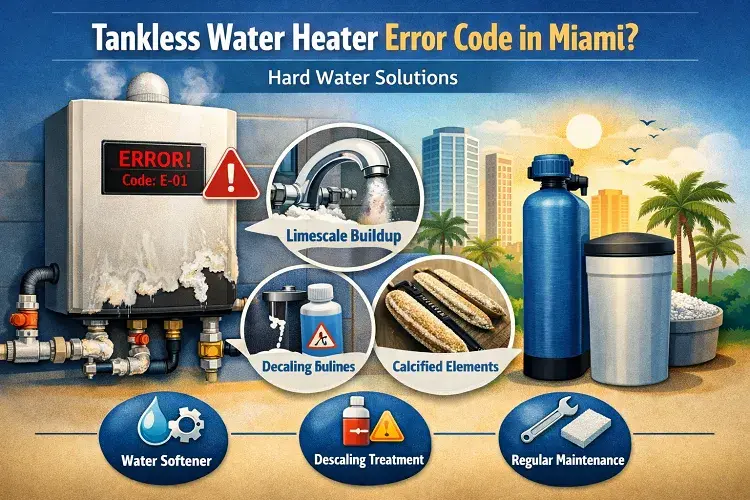
While tankless water heaters are incredibly efficient, they have a major vulnerability: the high mineral content derived from Florida’s limestone aquifers. When these minerals bake onto your system’s internal components, the unit throws an emergency error code to protect itself from burning out.
At Plumbing Repair Hub, we help Miami homeowners decipher these system warnings and restore their hot water on the spot. If your tankless water heater is actively flashing an error code and refusing to ignite, do not wait for the system to overheat and crack. Call our local 24/7 emergency dispatch line right now at (833) 205-7332 to get a certified technician to your door.
The Hidden Culprit: Miami’s “Very Hard” Water
To understand why your tankless water heater is struggling, you have to look at where Miami’s water comes from. The vast majority of Miami-Dade County relies on the Biscayne Aquifer, a shallow underground water source made almost entirely of porous limestone.
As rainwater filters down into the aquifer, it dissolves this limestone, packing your tap water full of calcium carbonate and magnesium. According to local water quality data, the Greater Miami Area features an average water hardness of 219 parts per million (ppm), which translates to roughly 12.8 grains per gallon (gpg).
According to the Water Quality Association, any water supply exceeding 10.5 grains per gallon is classified as “Very Hard.”
Water Hardness Scale (Grains Per Gallon)
[ 0 – 3.5 gpg ] -> Soft Water
[ 3.6 – 7.0 gpg ] -> Moderately Hard
[ 7.1 – 10.5 gpg]-> Hard Water
[ 10.5+ gpg ] -> VERY HARD (Miami Average: 12.8 gpg)
The Law of Inverse Solubility
Most minerals dissolve faster when the water gets hot. However, calcium and magnesium exhibit inverse solubility—meaning they solidify and precipitate out of the water much faster as temperatures rise.
When your tankless water heater fires up its powerful burners to instantly heat cold water, it creates an intense thermal zone. The dissolved minerals instantly turn into a rock-hard, chalky white crust known as limescale. This scale wraps around your heat exchanger, coats your temperature sensors, and chokes out your internal copper water lines.
Decoding the Screen: Common Tankless Error Codes Caused by Scale
Modern tankless units from major brands like Rinnai, Noritz, Rheem, and Navien are packed with advanced diagnostics. They don’t fail silently; they track system performance and shut down when parameters drift out of bounds.
When limescale clogs the system, it typically triggers one of four major failure profiles, regardless of the brand:
1. The Overheating Code (e.g., Rinnai Code 14, Noritz Code C1 / 11)
When a thick layer of limescale coats the inside of your heat exchanger, it acts as an insulation blanket. The burners have to fire hotter and longer just to transfer heat through the mineral crust to reach your target temperature. This causes localised hot spots, prompting the high-limit switch to trip to prevent the copper from warping or melting.
2. The Low Water Flow Restriction Code (e.g., Rheem Code 16, Navien Code E002)
As scale builds up inside the narrow, twisting passages of the heat exchanger, the internal pipe diameter shrinks. Your cold water pressure might be fine, but the hot water side is choked down to a slow trickle. Tankless units require a minimum flow rate—usually around 0.5 gallons per minute—to safely trigger the burners. If the scale drops the flow below that threshold, the system displays an error code and refuses to fire up.
3. The Combustion / Ignition Failure Code (e.g., Rinnai Code 11, Navien Code E003)
If the scale scales over the internal flame rods or ionising sensors, the computer can no longer detect if a flame is actually present. Even if the gas ignites, the system will shut down after a few seconds as a safety precaution because the blinded sensor fails to confirm a safe burn.
Why You Shouldn’t Just “Reset” the Code
When your water heater stops working, it’s tempting to simply unplug the unit, plug it back in, and hope the error code goes away. While a manual reset might temporarily clear the screen and give you a few minutes of lukewarm water, it does not solve the structural root cause.
Resetting a unit choked by Miami’s hard water is incredibly dangerous for the health of your appliance. Running a tankless water heater with an active scale blockage causes severe thermal stress, leading to:
Metal Fatigue: The constant overheating and cooling cause the copper lines inside the heat exchanger to crack, flooding the internal electrical components.
Voided Warranties: Manufacturer warranties from companies like Rinnai and Navien explicitly state that damage caused by mineral scale formation is not covered. If an emergency technician pulls out a cracked heat exchanger caked in white chalk, you will be on the hook for a replacement part that can cost over $1,000.
Warning for Miami Homeowners: If you hear a distinct popping, hissing, or rumbling noise coming from your tankless unit while it is running, that is the sound of trapped steam bubbles exploding under heavy mineral crust. Shut the system down immediately and call a professional.
The Solution: A Professional Food-Grade Chemical Flush
If your tankless unit is locked out by an error code, the only way to restore it is through a comprehensive diagnostic and professional descaling flush.
At Plumbing Repair Hub, our technicians execute a precise restoration process to safely dissolve the rock-hard limestone without damaging the sensitive internal components of your unit:
How Often Does a Tankless System Need Maintenance in Miami?
Because Miami water sits firmly in the “Very Hard” category, standard national maintenance advice does not apply here. While a homeowner in a soft-water region can get away with servicing their system every two to three years, Miami tankless water heaters require a professional descaling flush at least once every 12 months.
If you have a large household with high hot water demands, or if you keep your output temperature set above 120°F, you may even need a flush every 6 months to completely protect your investment.
Long-Term Protection: Consider a Scale Inhibitor
To prevent scale from forming rapidly between annual maintenance visits, ask our team about installing a dedicated tankless scale inhibitor system on your cold water inlet line. These compact cartridges inject food-grade polyphosphates into the water, which bind to the calcium ions and prevent them from crystallising when exposed to high heat.
Clear Your Error Code Today with Plumbing Repair Hub
Don’t let hard water destroy your high-end tankless water heater. If your system is throwing an error code, running hot and cold, or losing water pressure, the team at Plumbing Repair Hub is ready to help. We know Miami’s unique water infrastructure inside and out, and we carry the specialised tools and commercial descaling agents needed to clear your system safely.
Get your hot water back online before the scale causes permanent, irreversible damage to your heat exchanger.
Keep Reading: Mineral buildup doesn’t just cause errors; it can also affect your home’s water flow. Learn the common causes of low water pressure in homes and why you might hear a popping noise coming from your water heater.


