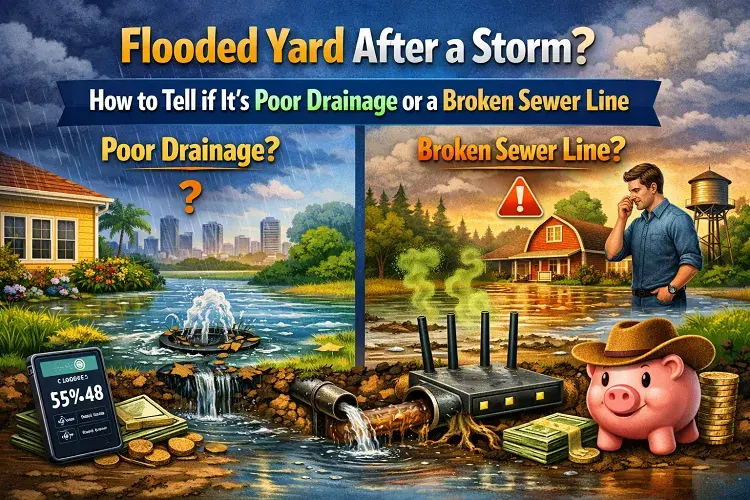
As a licensed plumber who has spent years troubleshooting residential drainage crises right after major storms, I’ve seen just about everything. I’ve crawled under thousands of foundations, scoped miles of sewer laterals, and stood in knee-deep yard water with anxious homeowners. When a massive downpour hits, a flooded yard is a common sight. But over my years in the field, the single most critical question I get called out to answer after a storm is this: “Is my yard flooded because the ground is saturated, or did the storm just break my main sewer line?”
Distinguishing between natural standing stormwater and a localized plumbing emergency is vital. If it’s just poor surface yard drainage, your grass might suffer, but your home is relatively safe. However, if the sheer volume of stormwater or shifting soil has fractured your underground main sewer line, that standing water is a ticking biohazard. Left unaddressed, it will wash away your foundation, destroy your landscaping, and eventually force raw sewage straight backward into your home’s low fixtures.
At Plumbing Repair Hub, we don’t guess when it comes to your property’s safety. We back up our field experience with advanced pipeline diagnostics. If your yard is holding water long after the rain stops, or if you notice a distinct, foul smell near the pooling water, don’t wait for the ground to erode. Call our emergency dispatch line at (833) 205-7332 immediately to have a certified sewer technician dispatched to your property.
The Field Assessment: Saturated Ground vs. Structural Pipe Failure
When I roll up to a home with a flooded yard after a storm, I immediately look for specific physical indicators. Over my years of hands-on experience, I’ve developed a diagnostic checklist to determine whether the issue is systemic poor grading or a structural sewer line break.
Here is exactly how I break down the symptoms on-site to find the true root cause:
1. The Smell Test (The Easiest Indicator)
Poor Surface Drainage: The pooling water smells like wet dirt, stagnant rain, or decaying grass. It’s muddy, but it doesn’t cause you to wrinkle your nose when you walk past.
Broken Sewer Line: The water pooling in your yard has a distinct, unmistakable foul odor—either a sharp rotten-egg sulfur smell or a heavy sewer stench. If you notice toilet paper fragments, dark murky sludge, or solid waste bubbling up into the grass, your main sewer line has definitely structurally failed or backed up completely. You need to call immediate Sewer Line Repair services who can help you fix the problem.
2. Rate of Recession (How Long Does the Water Sit?)
Poor Surface Drainage: In my experience, even highly compacted clay soils will slowly absorb standing stormwater over 24 to 48 hours once the storm passes. The water level will drop steadily as it evaporates and percolates.
Broken Sewer Line: The water level remains exactly the same or actually increases even when the sun is shining, especially when your family runs a load of laundry, runs the dishwasher, or takes a shower. If the pool grows when indoor fixtures are active, your household wastewater is discharging directly into your yard instead of the city main.
3. The “Sinkhole” and Soil Displacement Factor
Poor Surface Drainage: The water sits evenly across a low-lying basin, a dip in your lawn, or a poorly graded swale near your property line. The ground beneath the water is soft, but it remains uniform.
Broken Sewer Line: You notice a specific, localized depression, a mini sinkhole, or a sudden cave-in directly along the path where your sewer lateral runs to the street. When an underground pipe breaks, the constant flow of water creates an underground vacuum that systematically washes the surrounding sand and soil down into the pipe, causing the earth above it to collapse.
Why Heavy Storms Break Underground Sewer Pipes
Many homeowners ask me, “If the pipe is underground, how does a rainstorm break it?” It seems counterintuitive, but storms subject buried infrastructure to immense physical forces. In my years servicing lines, I’ve found three primary culprits behind storm-driven sewer failures:
1. Infiltration, Inflow, and Hydrostatic Surcharge
When a torrential downpour drops inches of rain, the soil becomes a heavy, liquid slurry. This drastically increases the hydrostatic pressure pushing against the outside of your buried pipes. If you have an older sewer line with fragile joints, this sudden external water weight can compress or shift the earth, snapping a rigid line. Simultaneously, if the municipal city main fills with stormwater, it backs up toward your house, creating intense internal pressure that can blow out weakened pipe seams.
2. Soil Shifts and Pipe Shear
As the ground switches from completely dry to deeply saturated, expansive soils shift and settle unevenly. If your main sewer line runs beneath a concrete walkway, driveway, or patio, the uneven settling of the ground creates a “shear point.” The heavy concrete pushes down while the soft earth shifts outward, snapping the buried pipe right at the edge of the slab.
3. Aggressive Root Displacement
During a major storm with high winds, large trees on your property rock violently back and forth. This movement causes their massive underground root structures to leverage and twist deep in the soil. If tree roots have already wrapped around or penetrated your old cast-iron or clay sewer pipes, the rocking motion of the tree acts like a crowbar, physically tearing the pipe connections apart underground.
Modern, Durable Structural Repair Options
If our diagnostics confirm that your flooded yard is due to a broken sewer line, we don’t automatically bring out heavy excavators to trench through your pristine lawn. Depending on the depth, location, and severity of the fracture, we utilize modern plumbing technologies:
Trenchless CIPP Lining (Cured-in-Place Pipe): If your pipe is cracked or missing its floor but still holds its structural circular shape, we can repair it without digging. We slide an epoxy-saturated sleeve inside the old pipe, inflate it, and let it cure. It creates a brand-new, seamless, root-proof pipe inside your old one that lasts for over 50 years.
Pipe Bursting: If the pipe is completely collapsed, we can pull a heavy-duty bursting head through the old line, fracturing the old pipe outward while simultaneously pulling a brand-new, seamless HDPE (High-Density Polyethylene) pipe in behind it, requiring only two small access pits.
Targeted Spot Repair: If the break is localized to a single, easily accessible section away from driveways or mature trees, we execute a precise excavation to swap out the broken segment with modern schedule PVC and heavy-duty shield couplings.
Services from Plumbing Repair Hub
- Non-Destructive Electronic Slab Leak Detection
- Trenchless Sewer Pipe Repair & CIPP Lining
- Commercial-Grade Hydro-Jetting & Drain Clearing
- Advanced Water Heater Descaling & Repair
- Storm-Ready Sump Pump & Foundation Drainage Installation
Protect Your Foundation: Call Plumbing Repair Hub Today
Standing water near your home’s foundation should never be ignored. If that water is mixed with underground sewer leakage, it will rapidly destabilize the soil support structures beneath your house, leading to foundation cracks and severe property depreciation.
Lean on my years of first-hand field experience. Let the professional team at Plumbing Repair Hub accurately diagnose your yard drainage issues, clear out storm blockages, and structurally restore your sewer infrastructure with honest, upfront pricing.
Don’t let a hidden pipe failure compromise your property. Call our team right now at (833) 205-7332 to schedule an expert camera inspection and get your yard draining perfectly again.
Keep Reading: Is it bad drainage or a broken pipe? Learn the signs of an under-slab pipe leak and why you might experience sewage backing up after heavy rain.